CNC milling (Computer Numerical Control Milling) is a highly sophisticated subtractive manufacturing technology that has transformed modern industrial design and hardware fabrication. Renowned for its exceptional accuracy, operational efficiency, and geometric versatility, CNC milling is the preferred manufacturing method across high-tech sectors. This article presents a comprehensive guide to CNC milling-exploring its foundational concepts, dynamic working principles, machine configurations, material compatibility, and global industry applications-along with how specialized precision manufacturing partners like CS Rapid MFG deliver modern CNC milling solutions.
Definition and Basics of CNC Milling
CNC milling is an automated subtractive manufacturing process that uses digitized computer instructions to guide rotary cutting tools, removing excess stock from a raw workpiece to yield precise three-dimensional parts. Unlike manual milling-where an operator controls feed levers and spindle motion by hand-CNC milling relies on pre-programmed G-code algorithms to automate cutting execution, delivering micro-level precision, repeatability, and complex geometric freedom.
A standard CNC milling setup comprises three core components:
Machine Tool Structure: Provides the heavy rigid bed, column, high-speed spindle, and multi-axis worktable to support the workpiece and cutter.
Control Unit (The Controller): The digital processing module that interprets G-code instructions and transmits precision electrical impulses to multi-axis drive motors.
Rotary Cutting Tool: End mills, face cutters, ball-nose cutters, or drill bits designed to shear off material at elevated cutting speeds.
In a digital CAD/CAM workflow, design engineers first construct a accurate 3D model in CAD (Computer-Aided Design) software. CAM (Computer-Aided Manufacturing) software then analyzes the 3D geometry to calculate optimal tool paths, feed rates, step-overs, and spindle speeds, generating machine-ready G-code. This digital continuity ensures physical components conform exactly to initial engineering specifications.
Working Principles of CNC Milling
CNC milling machines execute material removal based on dynamic multi-axis movement:
3-Axis Milling: The cutting tool moves along three linear axes-X (horizontal), Y (transverse/lateral), and Z (vertical).
4-Axis Milling: Integrates an additional rotation axis (typically the A-axis around X), enabling continuous rotary cutting or multi-indexed machining without manual repositioning.
5-Axis Simultaneous Milling: Moves tools continuously across three linear axes and two rotational axes (A/B or B/C). This setup enables the cutting tool to approach the workpiece from any compound angle, eliminating fixture setups and enabling complex organic curves-such as aerospace turbine impellers and organic medical implants-with superior surface quality.
Parameter Calibration
Prior to execution, raw stock is secured using precision vises, vacuum tables, or custom fixtures. Tool selection depends directly on material hardness; solid carbide end mills are preferred for tough alloys, while high-speed steel (HSS) or uncoated carbide tools suit softer non-ferrous metals and polymers. Engineers precisely balance spindle speed (RPM) and feed rate (mm/min) to optimize material removal rates (MRR), surface finish, and tool life.
Classifications of CNC Milling Machines
Vertical Machining Centers (VMC): Feature a vertically oriented spindle. VMCs are versatile and widely applied for top-surface profiling, pocketing, slotting, and drilling in small-to-medium manufacturing runs.
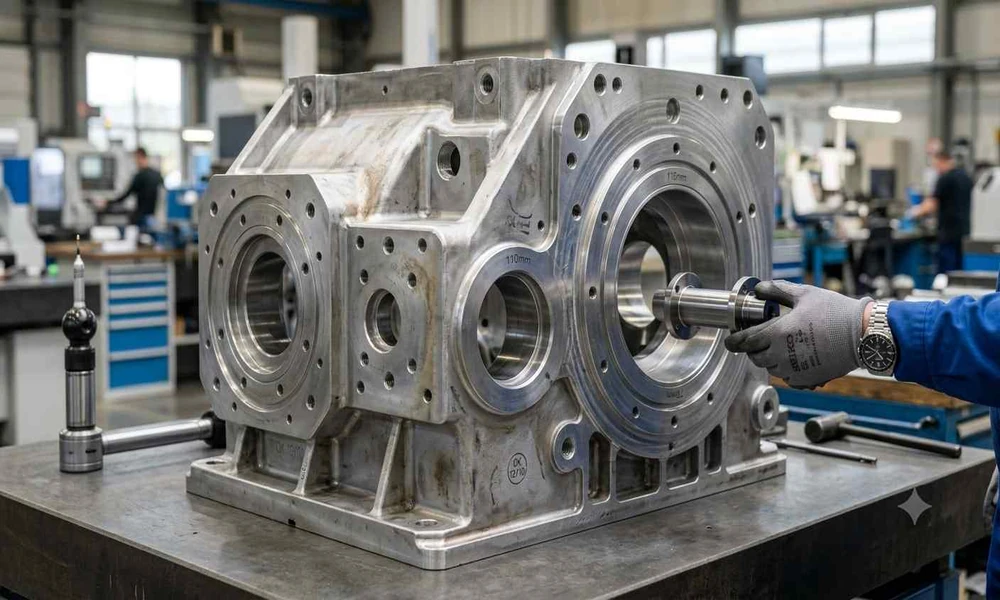
Horizontal Machining Centers (HMC): Utilize a horizontal spindle orientation, promoting natural gravity chip evacuation during heavy metal removal. HMCs are standard in high-volume, multi-sided tombstone machining for automotive engine blocks and structural housings.
Bed-Type Milling Centers: Engineered with high structural rigidity and heavy bases to support large, massive workpieces without table deflection, crucial for heavy industrial machinery frames.
Universal & Multi-Axis Machining Centers: Offer flexible multi-angle spindle adjustments or simultaneous 5-axis articulation, ideal for complex prototype development and mold cavity fabrication.
Materials Used in CNC Milling
CNC milling exhibits exceptional material versatility across metals, polymers, and natural materials:
Aluminum Alloys (6061-T6, 7075-T6): Valued for high strength-to-weight ratios, corrosion resistance, and outstanding machinability. Widely used for smartphone enclosures, drone frames, and aerospace structural parts.
Steels & Stainless Steels (304, 316, 4140, Tool Steels): Selected for high hardness, tensile strength, and wear resistance. Stainless grades are widely utilized in food processing and medical devices due to biocompatibility.
Engineering Plastics (PEEK, Delrin/POM, Polycarbonate, Acrylic): Offer low friction, electrical insulation, optical clarity, or high impact resistance for electronic housings, optical components, and safety shields.
Wood & Composites: High-density hardwoods and carbon fiber reinforced polymers (CFRP) are milled for specialized architectural fixtures, furniture, and lightweight motorsport parts.
Industry Applications & Complete Machining Services by CS Rapid MFG
Owing to its precision and material flexibility, CNC milling is an indispensable process across high-tech technology sectors:
Automotive & Robotics: Engine blocks, transmission housings, custom suspension arms, and robotic joint housings.
Aerospace & Defense: Jet turbine blades, structural airframe spars, landing gear actuators, and satellite brackets.
Medical Devices: Precision surgical handles, orthopedic bone plates, custom dental prosthetics, and diagnostic equipment hardware.
Consumer Electronics & Hardware: Anodized smartphone chassis, laptop frames, custom heat sinks, and luxury watch cases.
End-to-End CNC Milling Services by CS Rapid MFG
Executing complex digital designs into physical hardware requires advanced multi-axis infrastructure, rigorous quality control, and deep manufacturing expertise. CS Rapid MFG (CS Mold Co., Limited) is an ISO 9001:2015 certified global contract manufacturer specializing in custom CNC machining (including precision 3-, 4-, and 5-axis CNC milling and CNC turning), rapid prototyping, sheet metal fabrication, and injection molding.
Operating out of an expansive production facility equipped with over 80 high-precision CNC machines-including state-of-the-art Hermle and DUG 5-axis, 4-axis, and 3-axis CNC milling centers-CS Rapid MFG offers complete manufacturing solutions:
Precision Multi-Axis Milling: Seamless execution of low-volume rapid prototypes to high-volume end-use production parts with tight tolerances and exceptional surface finishes.
Integrated DFM Engineering & Rapid Lead Times: Free Design for Manufacturability (DFM) reviews on every project inquiry to optimize geometry and cost, with custom prototype parts machined and shipped in as fast as 3 to 5 days.
Flexible Order Quantities: Complete volume flexibility with NO Minimum Order Quantity (NO MOQ)-supporting single prototype models up to full production runs.
Quality Control & Surface Finishing: Complete ISO quality compliance, CMM dimensional verification, and a comprehensive suite of surface finishing treatments (e.g., anodizing, bead blasting, powder coating, electroplating).
To request a 12-hour instant quote or upload 3D CAD models for engineering review, visit the official platform at CS Rapid MFG.
Conclusion
CNC milling remains a core pillar of modern subtractive manufacturing technology. Its ability to process diverse metals and engineering plastics into complex, high-performance hardware drives innovation across global supply chains. By partnering with established contract manufacturing specialists like CS Rapid MFG, businesses can streamline their production workflows, accelerate product development cycles, and ensure uncompromised quality from rapid prototype to final production.